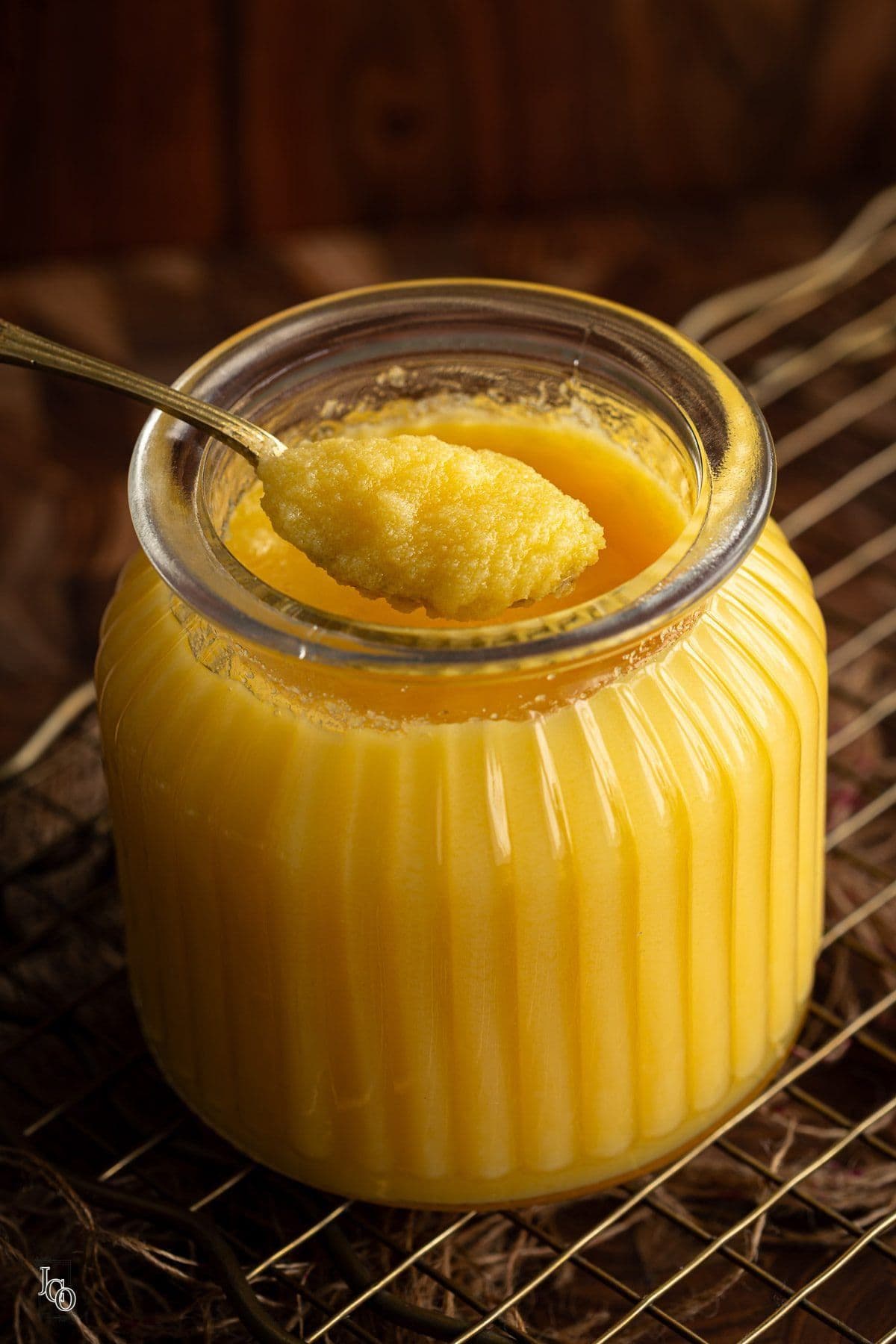
Homemade Ghee
Am I the only one who assumed ghee could only be procured from the green market on Sunday morning, or possibly from a very special Ayurvedic cow with ancient knowledge of the digestive qualities of cream? For an embarrassingly long time I treated it like a specialty import rather than something I could make in my own kitchen in fifteen minutes with one ingredient I already had.
I grew up with milk intolerance that showed up in my lungs before anyone connected the dots, and I learned early to quietly redirect my gaze away from the dairy aisle. It became habit. So ghee, shelved with the oils rather than the butter, sat outside my awareness for longer than it should have. When I finally looked into it, I understood why it lives in a different category entirely. Ghee is butter with the milk solids and water removed through a slow clarifying process. What remains is pure fat, and it is that removal that makes it tolerable for most people with dairy sensitivity or lactose intolerance. If your reaction to dairy is a true immune response to casein or whey proteins, proceed with more caution, as trace amounts can remain. But for those of us who grew up simply knowing that dairy did not agree with us, ghee is often a very different story.
One pound of butter. Fifteen minutes. A clean glass jar. That is the whole project.
Serves: 8 | Time: 15 minutes
Pure clarified butter fat with the milk solids and water removed. Shelf-stable, high smoke point, and far more digestible than butter for most people with dairy sensitivity.
INGREDIENTS
1 pound unsalted butter, organic and grass-fed where possible
METHOD
Place butter in a heavy medium-sized saucepan over medium heat. Let it melt fully without stirring.
Reduce heat until the butter reaches a gentle boil. Do not cover the pot. It will foam, sputter, and smell faintly of popcorn. This is exactly right. Whitish curds will begin to settle on the bottom.
After about 15 minutes, the foam on top will thin and the liquid will shift to a clear, golden color. Use a clean dry spoon to gently move the foam aside and check that it is clear all the way through to the bottom. When it has gone quiet and still, it is ready. Do not walk away at this stage — it can burn quickly.
Remove from heat and allow to cool until just warm. Pour through a fine mesh sieve or cheesecloth into a clean, completely dry glass jar with a tight lid. Discard the curds. If it smells nutty and looks slightly brown, it has gone too far.
On grass-fed butter: The butter is the entire ingredient list, which means quality matters more here than in almost any other recipe. Grass-fed butter means higher omega-3s, more conjugated linoleic acid, and significantly better flavor. Kerrygold is widely available and a reliable starting point.
On storage: Ghee does not need refrigeration. Store covered at room temperature and the flavor will deepen over time. Never introduce a wet spoon into the jar — moisture will spoil it. One pound of butter fills roughly one jar. Two pounds fills a quart.
On the Ayurvedic view: Ghee has been a cornerstone of Ayurvedic cooking and medicine for thousands of years. It is considered a digestive aid that improves absorption, lubricates connective tissue, and acts as a carrier — taking the properties of whatever it is cooked with more deeply into the body. It is generally balancing across all body types in moderate amounts. Photo & recipe adapted from https://www.jcookingodyssey.com/homemade-ghee/