By Michelle Boren, Founder of SacredLee
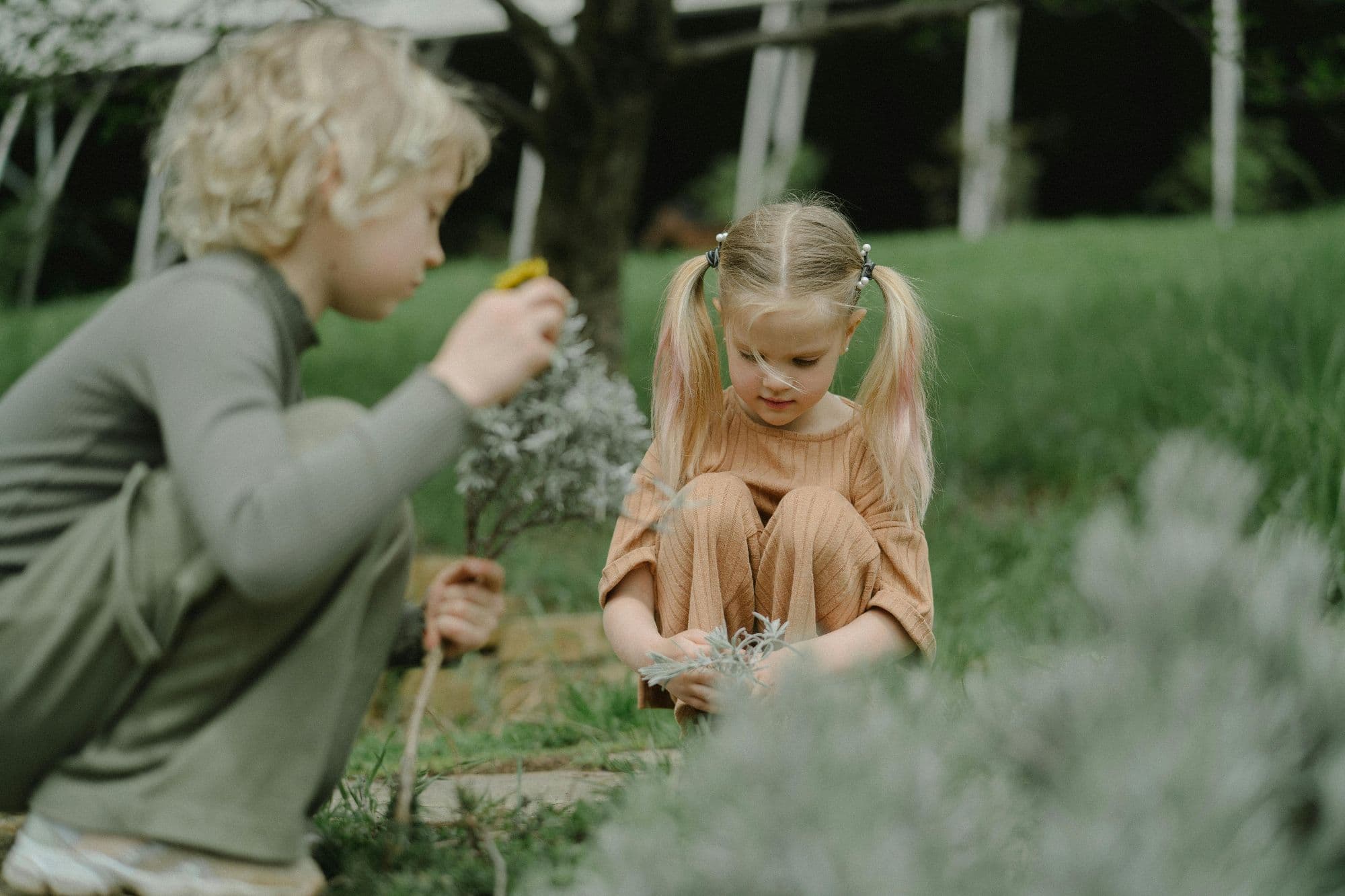
Children's outdoor play gives kids something structured exercise indoors cannot fully replicate: natural light exposure, changing terrain, environmental microbial diversity, distance vision, weather variation, and direct contact with the living world. The research increasingly treats this as a developmental input, not just recreation.
A child running through a gymnastics gym is moving. A child jumping for an hour at an indoor bounce house is moving. And a child racing across a field, climbing a tree, digging in soil, or wandering through the woods is moving too.
All of these can be good for them.
But they are not biologically identical experiences. We tend to think about getting children outside as recreation. Increasingly, the research suggests we should think about it as part of development.
What Does the Research Show About Children's Outdoor Play?
Children's bodies and brains receive different inputs outdoors than they do inside.
Nature and attention. Research on green-space exposure and childhood attention is still developing, but a 2024 systematic review found that the studies it examined consistently associated nature exposure with reduced ADHD diagnoses or symptom severity. Importantly, this does not mean nature "treats ADHD," and not every experimental study has found an attention benefit. The larger body of evidence suggests an association worth taking seriously.
Outdoor time and development. A systematic review of longitudinal and intervention studies notes that spending more time outdoors can support physical activity as well as children's social and cognitive development and vision.
Screens and sleep. In a study of 715 infants and toddlers, greater touchscreen use was associated with less nighttime sleep, more daytime sleep, and taking longer to fall asleep. The authors were careful to note that longitudinal research is needed to establish direction and causality. The sleep environment itself matters here too, Non-Toxic Bedroom Essentials covers what's worth looking at beyond screen habits.
Nature and the microbiome. This may be one of the most fascinating emerging areas. In a controlled daycare intervention, researchers brought forest-floor vegetation, sod, and other biodiverse natural materials into urban daycare yards. After only 28 days, children exposed to the more biodiverse environments showed changes in skin microbiota associated with changes in markers of immune regulation. A two-year follow-up found the differences in environmental and child-associated microbial communities persisted.
A later placebo-controlled, double-blind study exposed young children to sandbox material enriched with microbially diverse soil. Researchers again observed changes in skin microbial communities and immune-regulatory markers, strengthening the case that contact with environmental biodiversity may play a role in immune development.
That is something a treadmill, trampoline, or indoor play structure simply cannot provide.
Isn't Indoor Movement Enough?
I want to make this distinction because the goal is not to make parents feel that indoor activity somehow "doesn't count."
It absolutely does.
Gymnastics develops strength, balance, coordination, spatial awareness, confidence, and discipline. Dance does things for the body and brain that a walk may not. Indoor swimming, basketball, climbing, martial arts, and yes, an afternoon spent flying around a bounce house all get children moving.
Movement matters enormously.
But outdoor time brings additional biological inputs.
The light changes. The surfaces change. The air changes. The visual field expands. There are plants, soil, insects, microbes, wind, temperature shifts, shadows, sounds, and textures the child does not control.
And perhaps that is part of the point.
Indoors, we engineer environments for predictability. Nature rarely offers it.
A stick becomes a tool. A hill changes the way the body balances. A bug interrupts the plan. A tree asks a child to calculate risk. Soil gets under fingernails. Clouds change the light.
The child has to respond.
That kind of unstructured experience is very different from being entertained.
How Does Outdoor Play Shape a Child's Immune System?
For generations, children had far more routine contact with soil, plants, animals, and richly biodiverse outdoor environments. Urbanization has changed that relationship dramatically.
Researchers studying what is sometimes called the biodiversity hypothesis are asking whether reduced contact with diverse environmental microbes may affect the way the developing immune system learns to regulate itself.
The research is still young. We should not turn "go play in the dirt" into another oversimplified wellness prescription.
But the human intervention studies cited above are compelling enough to pay attention to. More recent research continues to investigate playgrounds and natural environments as living microbial interfaces between children and the ecosystems around them.
The immune system, it turns out, may be learning not only from what children eat and what pathogens they encounter, but from the biodiversity surrounding them.
What Is Screen Time Displacing?
This conversation is not really about making screens the villain either. Technology is part of childhood now.
The more useful question is what screens may be displacing.
An hour on a tablet is not simply an hour of screen exposure. Depending on the child and the time of day, it may also be an hour not spent moving, looking into the distance, interacting face-to-face, experiencing daylight, inventing a game, getting dirty, becoming bored, or figuring out what to do next.
That distinction matters.
Screens provide intense, predictable stimulation. The natural world asks for participation. Those are different developmental experiences, and children need room for both technology literacy and life beyond technology.
Where You Have Agency
This does not require turning children's outdoor play into a childhood spent hiking national parks. It can be remarkably ordinary.
Open the door after breakfast and let morning daylight in. Walk to school when life allows it. Eat dinner outside. Move homework to the porch. Let children collect rocks, build something useless out of sticks, garden badly, climb, wander, get sweaty, and occasionally announce that they are bored. Choose the playground with trees when you have the option.
Keep the gymnastics class. Keep the basketball practice. Go to the bounce house on the rainy Saturday.
Then, when the weather clears, go outside too.
The goal is not to replace structured exercise with nature. It is to remember that fitness and outdoor exposure are not interchangeable. Children need movement. But they also benefit from daylight, biodiversity, sensory variation, open space, and experiences that have not already been designed for them. If you're looking for other easy starting points around the house, Non-Toxic Living: 5 Swaps to Make First covers the basics.
A SacredLee Perspective
Perhaps what children need from us is not another perfectly optimized schedule.
Perhaps they need access to some of what childhood once provided naturally. Sun on their faces. Dirt on their hands. Space to move without being instructed how. Enough boredom for imagination to arrive. Enough time outside for the body to encounter a world that is alive, unpredictable, and larger than a screen.
We cannot recreate the childhoods that came before ours, nor should we romanticize them. But we can protect pieces of what biology still recognizes.
Movement matters. Exercise matters. And the living world offers something more.
Sometimes the simplest gift we can give a child is unstructured children's outdoor play: the freedom to go outside.