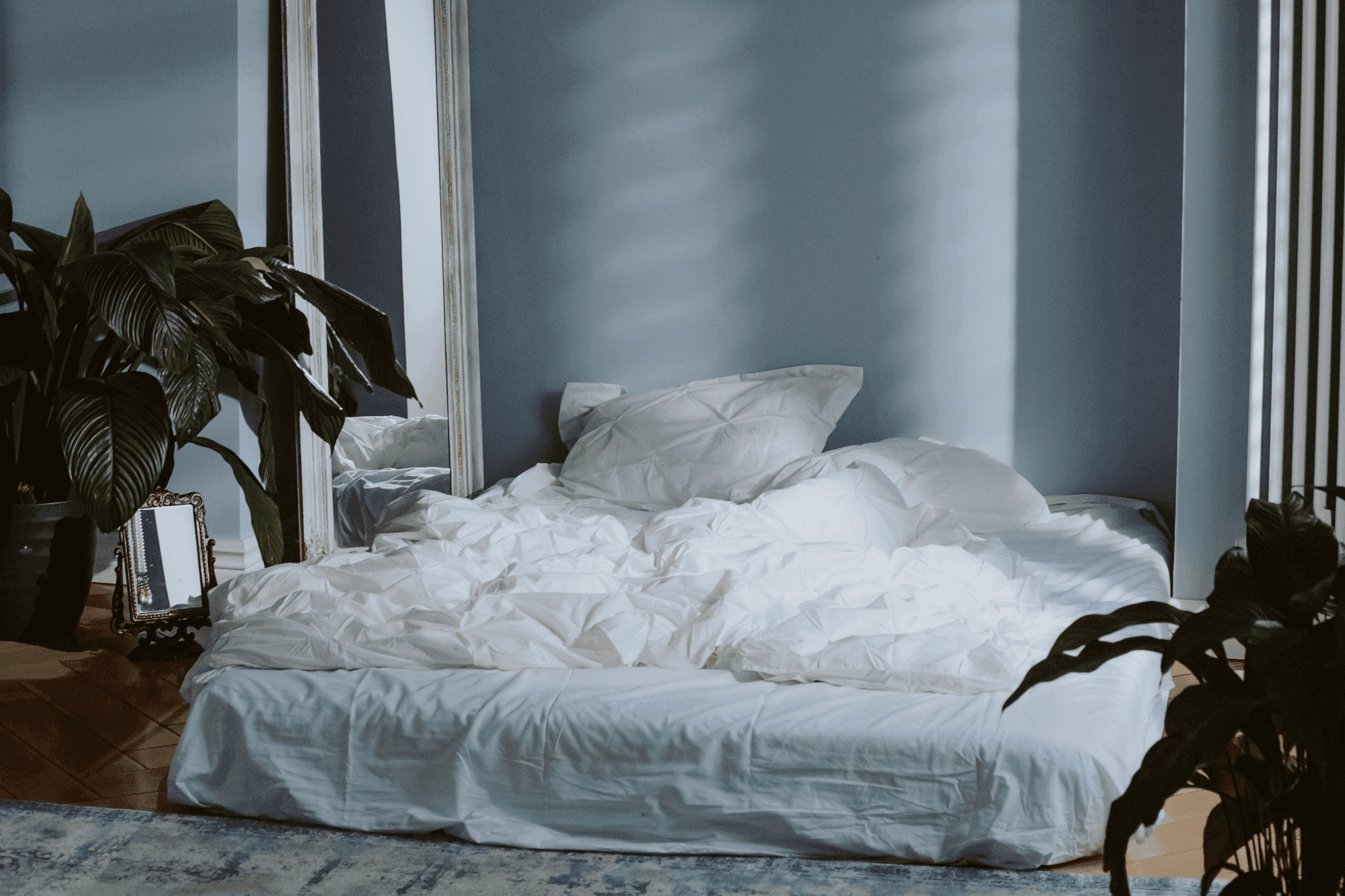
We will spend hours picking out a couch or debating a rug, and far less time asking what is touching our skin, and what we are breathing, while we sleep. This guide walks through it category by category: what is worth buying, what to check on the label, what to skip no matter how it is marketed, and the products we have vetted in each one.
In this guide: Where You Restore, Bed Frame, Mattress, Bedding, Air Quality, The Rug You Step Onto, Lighting, A Realistic Way to Set It Up, and a few questions worth answering.
Where You Restore
"Sleep is the golden chain that ties health and our bodies together." (Thomas Dekker)
A third of your life happens in this room. The mattress off-gasses for years. The sheets carry chemical finishing treatments that spend every night pressed against your skin. The pillow is the closest material to your face and airways for eight hours without interruption.
Sleep is not passive. It is the only window your body has to repair, restore, and recalibrate. What surrounds you in those hours either supports that work or quietly interferes with it.
This is where the body does its most sacred work.
None of this means every conventional product in your home is working against you. It simply means what rests closest to your body matters most, and your bedroom holds more of that closeness than almost anywhere else.
A nervous system that cannot fall into that restorative window night after night is not just losing sleep. It is often the earliest sign of a body that is not regulating, which is exactly where the next guide in this series picks up. [Read: The Sacred Nervous System]
Bed Frame
Wood furniture is often treated with formaldehyde-based glues and finishes, especially in pressed wood or particleboard frames, which makes the frame one of the more overlooked sources of indoor air exposure in the room. Solid wood is worth prioritizing whenever it fits your budget, and FSC certification is the marker to look for, since it confirms the wood came from a responsibly managed forest. GREENGUARD Gold certification is another strong signal specifically for furniture, since it tests for chemical emissions after assembly. The one thing to walk away from is a frame with a strong chemical smell straight out of the box. That smell is off-gassing, and it can linger for weeks.
Free swap: If your current frame is pressed wood, move it near an open window and let it breathe for a few weeks. Skip particleboard next time. Accessible: A solid wood vintage or secondhand frame skips the new-finish off-gassing and usually costs less than buying new. Meaningful investment: Madera White Oak Bed Frame, FSC certified, by Naturepedic or The City Bed Frame, FSC certified, by Avocado.
Mattress
You will spend nearly a third of your life on your mattress, making it one of the most important health investments in your home. Look for mattresses made with GOTS-certified organic cotton and wool, paired with a GOLS-certified natural latex core. These certifications help ensure you're getting genuine organic materials rather than clever marketing claims. OEKO-TEX® Standard 100 is another valuable certification, verifying that the finished product has been tested for harmful substances.
Avoid vague terms like "proprietary foam blend," which often reveal little about what's actually inside. Choose natural wool instead of chemical flame retardants whenever possible—wool is inherently flame resistant and eliminates the need for unnecessary chemical treatments.
And remember: if you can smell it, you're breathing it. A strong chemical odor is a sign that a foam mattress or topper is releasing volatile organic compounds (VOCs) into your bedroom air. These chemicals can contribute to headaches, dizziness, throat irritation, and may be especially problematic for those with asthma, allergies, or chemical sensitivities. If a new mattress or topper has a noticeable odor, let it air out in a well-ventilated space before bringing it into your bedroom. Or better yet, choose natural materials that don't rely on chemical foams in the first place.
Your bedroom is where your body repairs, restores, and recalibrates. The air you breathe there should support that work, not compromise it.
Free swap: Air your current mattress often and ventilate the room. Let any new mattress off-gas before you sleep on it. Accessible: An organic cotton or wool mattress protector and topper by Avocado is a meaningful, lower-cost first layer between you and what you already own. Meaningful investment: Simplicity Mattress by SavvyRest or The Main REM Mattress by Coyuchi.
Bedding
The fabric your skin meets for the longest stretch of any hours in your day deserves the most intention of anything in this room.
Sheets
GOTS certified organic cotton or linen is what to look for here, and the certification matters more than the word "organic" on its own, since that word alone is not a regulated claim. Skip anything labeled "wrinkle free" or "easy care." That finish is almost always a formaldehyde-based resin treatment.
Free swap: Stop buying anything labeled wrinkle free or easy care, and wash new sheets before the first night. Accessible: OEKO-TEX certified cotton at a mid price is a real step up from conventional. Vetted investment: Signature Hemmed Sheet Set by Boll & Branch or Organic Print Percale Sheet Set by Coyuchi.
Pillows
Natural latex, wool, or organic cotton fill hold up better than synthetic over time, and GOLS certification for latex or OEKO-TEX Standard 100 for anything not fully organic are the markers worth checking for. Memory foam pillows can off-gas noticeably when new, and conventional polyester fill is petroleum based. Both are worth passing on.
Free swap: Retire memory foam and polyester pillows as they wear out. Accessible: An OEKO-TEX certified cotton or wool pillow. Vetted investment: Down Pillow with Organic Cotton Fabric by Naturepedic or Organic Wool Pillow by SavvyRest.
Duvet Insert
Down or wool fill wrapped in a GOTS certified organic cotton shell is the combination to look for, with the certification applying to the shell fabric specifically. Synthetic polyester fill is harder to keep clean long term and does not breathe the same way, so it is worth skipping here too.
Free swap: Use the natural-fill duvet you already own and air it in the sun. Accessible: A duvet with an OEKO-TEX certified cotton shell. Vetted investment: Lightweight Down Duvet Insert by Coyuchi.
Air Quality
The air you breathe while you sleep deserves just as much attention as the food you eat. For six to nine hours each night, your body is repairing, detoxifying, and restoring itself. Every breath matters.
A true HEPA air purifier is one of the simplest ways to reduce dust, pollen, pet dander, mold spores, and other airborne particles that can quietly burden your body. Choose one sized for your bedroom, and look for True HEPA rather than "HEPA-type," which is a marketing term, not a certification.
Just as important is what you remove. Plug-in air fresheners and paraffin candles continuously release synthetic fragrance and volatile chemicals into the very air you're breathing all night. Save your money. Open a window when you can, and if you enjoy candlelight, choose beeswax or coconut wax with a cotton wick instead.
Plants have a place here too—not because they'll purify your air in any meaningful way, but because they'll change how the room feels. Research shows that simply being around living plants can lower stress and encourage the nervous system to shift out of fight-or-flight. Let your air purifier clean the air. Let nature help your body exhale.
Free swap: Open your windows ten minutes a day, and remove plug-in fresheners and paraffin candles. Accessible: A correctly sized true HEPA unit, plus a beeswax or coconut wax candle if you want scent. Meaningful investment: Jaspr Air Scrubber, code SACREDLEE for $200 off.
The Rug You Step Down Onto
This one deserves its own category because it's the first thing your bare feet touch every morning and the last thing they touch before bed. Unfortunately, it's also one of the hardest home products to get right. Walk through any home goods store and you'll find hundreds of fashionable rugs under $200, but nearly all are made from polyester, or other petroleum-based fibers, often treated with stain-resistant finishes and synthetic backings. With every step, they shed microscopic plastic fibers into the room where you sleep.
Rather than covering your entire bedroom with a synthetic rug, consider using less. A pair of small, washable wool rugs beside the bed gives your feet a natural landing place without filling the room with unnecessary synthetic materials. Wool is naturally durable, moisture and odor resistant, and doesn't shed microplastics like its synthetic counterparts.
Sometimes the healthiest choice isn't replacing everything, it's simply choosing the few things that matter most.
Free swap: Take the synthetic rug out of the bedroom. A clean bare floor beats a shedding rug. Accessible: One small wool runner on the side you step out of bed. Vetted investment: Handknotted Wool Rug by Coyuchi.
Lighting
Rarely on anyone's non-toxic checklist, but it earns a place here for two reasons: material and melatonin. A solid wood, ceramic, or metal lamp base with a twisted cotton cord, paired with a warm 2700K bulb, addresses both at once. Vinyl or PVC-coated cords are worth avoiding, along with cool white or blue-toned bulbs in the evening, which work against your body's natural wind-down.
Free swap: Switch evening bulbs to warm 2700K, sold anywhere, and dim blue light at night. Accessible: A solid wood, ceramic, or metal lamp with a cotton cord.
A Realistic Way to Set Up Your Bedroom
You do not need to replace everything in this room at once. Start with sheets and pillows, since those touch your skin most directly, then work outward toward the mattress, frame, and air quality pieces as they naturally wear out or as your budget allows. This is a foundation you build over time, not a checklist to finish this weekend. If you want to work through the whole home this way, our Clean Home Audit covers it room by room.
Frequently Asked Questions:
What is the safest mattress material? Natural latex certified to GOLS, layered under GOTS certified organic cotton and wool, is the safest widely available combination. The wool provides flame resistance without chemical retardants, and natural latex avoids the polyurethane that off-gasses in conventional foam.
What should I prioritize first if my budget is limited? Sheets and pillows. Both touch your skin directly for hours every night, and both are more affordable than a mattress or frame replacement.
How long does a new mattress off-gas, and how do I get rid of the smell? The off-gassing is heaviest in the first three days and usually drops by half or more within a week, but polyurethane foam can keep releasing at lower levels for weeks. Unbox a new mattress in a well-ventilated room, open the windows, run a fan or purifier, and give it several days before sleeping on it. A strong chemical smell that will not fade is a reason to return it.
Are memory foam mattresses toxic? Memory foam is polyurethane and can off-gas volatile compounds, especially when new and when warmed by your body overnight. It is not that one night harms you. It is the years of nightly contact and breathing. If replacing it is not possible right now, ventilate well and add an organic cotton or wool topper and protector.
Is a fully natural mattress worth the investment? It is one of the more meaningful upgrades in the room given how much time you spend in direct contact with it. If it is not accessible right now, a mattress protector and topper is a reasonable place to start instead.
What does GOTS certification actually mean? GOTS is the Global Organic Textile Standard. It certifies both that the fibers are organically grown and that the entire processing chain, including dyes and finishes, meets strict environmental and safety limits. That is why it is more trustworthy than the word "organic" on its own, which is not a regulated claim for textiles.
What is the difference between GOTS and OEKO-TEX? GOTS certifies organic fiber plus clean processing from farm to finished goods. OEKO-TEX Standard 100 tests the finished product for harmful substances but does not require organic fiber. GOTS is the higher bar. OEKO-TEX is a solid baseline for anything not fully organic.
Do I need an air purifier in every bedroom? Not necessarily. It is worth considering if you deal with seasonal allergies, live somewhere with higher outdoor pollution, or you are making several other swaps at once and want help clearing lingering off-gassing while things settle.
Is the rug under my bed really worth swapping? More than most people expect. It is a small, one-time purchase that sits exactly where you breathe deepest and stand barefoot twice a day, which makes it a higher-impact swap than its size suggests.
What is the one certification I should look for across every category? GOTS for anything cotton-based, and OEKO-TEX Standard 100 as the baseline for finished textiles. Those two cover most of what matters in this room.
Is bamboo bedding non-toxic? It depends. Most bamboo fabric is actually rayon or viscose, which is chemically processed. Look for OEKO-TEX or GOTS certification, or choose bamboo lyocell, made in a closed-loop process, over conventional bamboo viscose.
How often should I replace my pillows? Every one to two years for most fills, sooner if they yellow or stop holding their shape. Natural latex and wool tend to last longer than synthetic or memory foam.
Are essential oil diffusers safe to run in the bedroom overnight? Used occasionally and well diluted, they are fine for most people, but run one intermittently rather than all night, keep the room ventilated, and skip synthetic fragrance oils. Homes with pets or anyone pregnant warrant extra caution, since some essential oils are not safe for them.
Make it sacred.
What rests closest to your body matters most, and for a third of your life, that is this room. Start with your sheets. Shop the For Sleep collection for every product in this guide.
This is educational content, not medical advice. Nothing here is meant to diagnose, treat, or replace care from a qualified practitioner.
Some links are affiliate links. We would rather lose the commission than lose your trust.
Sources: U.S. EPA, Indoor Air Quality (indoor air commonly two to five times more polluted than outdoor); Environmental Science and Technology (2019 and 2025), mattress VOC and semi-volatile emissions under sleeping conditions; Lee et al., Journal of Physiological Anthropology (2015), indoor plants and the autonomic nervous system stress response; research on formaldehyde-based durable-press textile finishes.