Air is the one thing you take in continuously, in every room, without a second thought. Unless you have ever struggled to catch your breath. Indoor air quality shapes far more of your daily life than most people ever stop to consider.
I had severe asthma as a child. More Februarys than I can count I spent coughing and wheezing, each breath coming with effort. Walking up a flight of stairs could leave me winded. Playing outside in the snow with friends was not always an option. There is a particular kind of panic that comes when your lungs want more air than they can draw in. In those moments, every breath feels like a gift.
Then we recover. And almost immediately, breathing fades back into the background, becoming automatic once again. Yet it is the one thing we cannot go more than a few minutes without. You can go days without food and hours without water, but only moments without air. And most of those moments happen indoors, which is exactly why indoor air quality deserves so much more attention than it gets.
That is the part worth sitting with. Research consistently shows that indoor air quality is often worse than the air quality outside. Indoor air can also carry higher concentrations of microplastics, volatile organic compounds, synthetic fragrance, mold spores, and other airborne pollutants that quietly accumulate inside modern buildings.
This is not just about one room. It is the bedroom where you spend a third of your life sleeping. The nursery where your baby takes their first breaths. The kitchen, the bathroom, the office, the living room. Every space contributes to the home air quality your body relies on thousands of times each day.
As we move through this guide, I will show you where the evidence is strongest, which exposures are most worth reducing, and where thoughtful changes to your indoor air quality truly make a difference. The goal is not to buy more. It is to breathe better. To expose yourself to less. That is the SacredLee way.
In this guide: Why Indoor Air Quality Matters, Ventilation, Your HVAC and Ducts, Filtration and the Best Air Purifier, Textiles and Dust, Scent and Combustion, Humidity and Mold, Best Indoor Plants for Air Quality, Your Action Plan, and a few questions worth answering.
Why Indoor Air Quality Matters
The air quality in your home is not the invisible, harmless background it often feels like. Synthetic textiles, upholstery, carpeting, and ordinary household dust continuously shed microscopic fibers. Every time you sit on the sofa, fluff a pillow, or vacuum the floor, some of those particles become airborne again.
New furniture, paint, pressed wood, synthetic mattresses, and rugs also release volatile organic compounds, the "new" smell you sometimes notice and often do not.
We spend nearly 90 percent of our lives indoors, yet most of us think far more about the food we eat than the indoor air quality we breathe. The irony is that breathing is the one thing we never stop doing, which makes home air quality one of the highest-leverage places to focus your attention.
The goal here is reduction. Perfect air does not exist, and chasing perfection will only leave you feeling overwhelmed. What we can do is ventilate well, filter the rooms where we spend the most time, and gradually remove the materials that contribute the greatest burden. Think of this page as a companion to the Bedroom and Nursery guides. Air quietly connects every room in the home, and indoor air quality is never just a one-room project.
Ventilation
The cheapest, most effective thing you can do for your indoor air quality costs nothing. Fresh air was never meant to be a luxury. For most of human history, it simply was.
Cross-ventilation, air moving in one window and out another, measurably dilutes the concentration of indoor particles. Modern homes are sealed far more tightly than the air inside them warrants, which lets pollutants linger longer than they otherwise would.
But the single most important place to ventilate is the stove. Cooking is one of the largest sources of indoor air pollution, and it is worse with gas. Stanford researchers found that gas stoves raise indoor nitrogen dioxide to levels linked to real health harm, and that cooking on gas can release benzene, a carcinogen, at concentrations that drift from the kitchen into bedrooms. The fix is a range hood that actually vents outside, not a recirculating one that filters the air and blows it back into the room. Run it every time you cook, use the back burners since hoods capture them better, and leave it running for ten to fifteen minutes after.
Here is the part almost no one knows: make-up air. When a powerful hood or fan pushes a lot of air out of a tight home, that air has to be replaced from somewhere. If it cannot come in easily, the house goes slightly negative and can pull air backward down the flue of a gas water heater or furnace, dragging combustion gases like carbon monoxide back inside. For most homes, simply cracking a nearby window while you run a strong hood gives it the make-up air it needs. High-power hoods, over about 400 CFM, often need a dedicated make-up air system that opens automatically when the hood runs. A carbon monoxide detector near sleeping areas and combustion appliances is non-negotiable.
Free Swap: Open your windows for ten minutes each day, ideally two on opposite sides for cross-flow. Run bathroom and kitchen exhaust fans while showering and cooking, and always run the range hood when you cook, especially on gas, cracking a nearby window to give a strong hood its make-up air. Accessible: A simple window fan to pull fresh air through when the weather does not cooperate, and a carbon monoxide detector near sleeping areas and gas appliances. Vetted: A properly sized range hood ducted to the outside rather than recirculating, or for a tightly sealed home, a balanced ERV that brings in filtered fresh air while holding onto your heating and cooling.
Your HVAC and Ducts
The system that moves air through your home is also where mold and dust like to settle, in the ducts and on the damp coil where your air conditioning condenses water. Two upgrades address it and both feed directly into your home air quality. A germicidal UV-C light, sometimes sold as a blue light, installs inside the system near the evaporator coil and drain pan, where it uses ultraviolet light (usually 254 nanometers) to break apart the DNA of mold, bacteria, and viruses so they cannot grow. It keeps the coil clean and the air passing over it cleaner. More advanced models pair the UV-C light with a carbon cell to also reduce household odors and VOCs. And every so often, if the ducts hold visible mold, dust, or debris, or after a renovation, a professional duct cleaning clears what has built up where you cannot see or reach.
Free Swap: Change your HVAC filter on schedule, and choose the highest MERV rating your system can handle. It is the cheapest thing you can do for the air moving through your whole home. Accessible: A professional duct cleaning when the ducts are visibly dirty, mold-prone, or fresh off a renovation. Not a routine expense, but worth it when the system needs it. Vetted: A germicidal UV-C light installed at the coil, such as the Fresh-Aire Blue-Tube UV, the OdorStop OS72, or the RGF BLU QR, around $200. For odors and VOCs as well, a combination unit like the Fresh-Aire APCO-X.
Filtration and the Best Air Purifier
This is the centerpiece of the room, and where the marketing gets slippery. A good air purifier is one of the most direct ways to improve indoor air quality, but not every air purifier on the market does what it claims.
Look for two things working together: true HEPA filtration and activated carbon. HEPA captures fine particles like dust, pollen, pet dander, and many airborne microplastics. Activated carbon captures gases, VOCs, odors, and many of the compounds associated with mold. An air purifier with HEPA alone leaves half the job undone.
Match the unit's recommended coverage area (CADR) to the size of your room, and walk past anything labeled "HEPA-type" or "HEPA-like." Those are marketing terms, not recognized filtration standards. A correctly sized air purifier running consistently will almost always outperform an oversized one left on low out of habit, or opt for a more advanced model with an intelligent mode like the Jaspr Air Scrubber, one of the best air purifier options for homes serious about air quality.
What Makes the Best Air Purifier for Your Home
The best air purifier for most homes pairs true HEPA with activated carbon in a single unit, sized correctly for the square footage of the room, and run continuously rather than turned on only when something smells off. An oversized budget can go to waste on the wrong feature set; a correctly matched, consistently running unit will almost always outperform a flashier one left idle.
Free Swap: Clean or replace your current air purifier's filter on schedule so it performs optimally. Accessible: A correctly sized true-HEPA-plus-activated-carbon air purifier for your main room. Vetted: Jaspr Air Scrubber, medical-grade HEPA plus activated carbon, the combination that mold and mycotoxin exposure actually requires, and one of the best air purifier picks for whole-home air quality. Code SACREDLEE for $200 off.
Textiles and Dust
One of the largest ongoing sources of indoor particles is often hiding in plain sight: the soft surfaces around us.
Fleece throws, polyester curtains, synthetic rugs, upholstered furniture, and even some bedding continuously shed microscopic fibers into household dust. Dust itself is not inert. It becomes a resting place for many of the compounds that have slowly off-gassed from furniture, flooring, electronics, and other household products. This is the bedroom-and-bathroom expression of what we call the fast-fashion home in our The Microplastics Guide.
The goal is not to remove every synthetic item overnight. It is to begin replacing the surfaces that shed the most and that stay in closest contact with your body.
Free Swap: Remove shoes at the door. Dust with a damp cloth rather than a dry duster that sends particles back into the air. Shake linens outside when possible, and begin by removing synthetic rugs from bedrooms, where you spend the greatest number of uninterrupted hours breathing. Accessible: A vacuum with true HEPA filtration, which traps fine particles rather than redistributing them, along with gradually replacing the highest-shedding synthetic textiles as they wear out. Vetted: Natural-fiber bedding, towels, and home textiles that meet the same material standards featured throughout our Non Toxic Bedroom Guide and The Fabric Guide.
Scent and Combustion
The plug-in air freshener, the incence, the scented candles and the febreeze quietly work against everything else on this page, releasing a steady stream of synthetic fragrance and volatile organic compounds into the air you breathe and lowering the air quality of the room.
Scent is not the problem. The delivery is. If you love a beautifully scented home, choose products that burn cleanly and use fragrance thoughtfully rather than continuously.
Free Swap: Remove plug-in air fresheners and paraffin candles entirely. Boil a cinnamon stick, sliced apples and a touch of vanillia to make your home smell cozy. Accessible: A beeswax or coconut wax candle with a cotton wick, or an essential oil diffuser, used intentionally rather than left going for hours. Vetted: A clean-burning beeswax or coconut wax candle made without synthetic fragrance.
Humidity and Mold
Few indoor air quality concerns affect health more than uncontrolled moisture, and both extremes cause problems. The sweet spot is 40 to 50 percent relative humidity, and a hygrometer, a small inexpensive gauge that reads the humidity in a room, takes the guesswork out.
Too much moisture, above roughly 55 to 60 percent, is the mold and dust-mite zone. Mold thrives anywhere water lingers, and it usually grows where you cannot see it: behind the washing machine's rubber door gasket, under a slow sink leak, along a bathroom ceiling, or on the damp coil and drain pan inside your HVAC. Its byproducts are exactly the kinds of airborne compounds activated carbon is built to reduce.
Too little moisture, below about 30 percent, is the winter-heating problem. Dry forced-air heat pulls moisture out of the air and out of you, leaving dry skin, scratchy sinuses, static, and cracking wood, and letting respiratory viruses linger longer.
For homes recovering from mold or persistent odors, ozone can be a helpful tool after the underlying moisture issue has been resolved. Because ozone is a powerful oxidizer, it should only be used in an unoccupied space, following all manufacturer instructions, with adequate time to ventilate before re-entering. Think of it as one layer of recovery, not a substitute for proper mold remediation.
Free Swap: Run bathroom and kitchen exhaust fans, address leaks promptly, leave the washing machine door open between loads so the gasket can dry, and improve airflow anywhere moisture tends to collect. Accessible: A humidity gauge to monitor rather than guess. A dehumidifier for any room that runs damp, or a cool-mist humidifier for dry winter air, cleaned often since a dirty humidifier becomes its own mold source. Vetted: Jaspr Air Scrubber, true HEPA plus activated carbon, the combination we recommend for homes recovering from mold exposure. If you suspect a significant mold burden in your body, our Detoxification guide explores more advanced protocols alongside qualified medical care.
A Word on the Best Indoor Plants for Air Quality
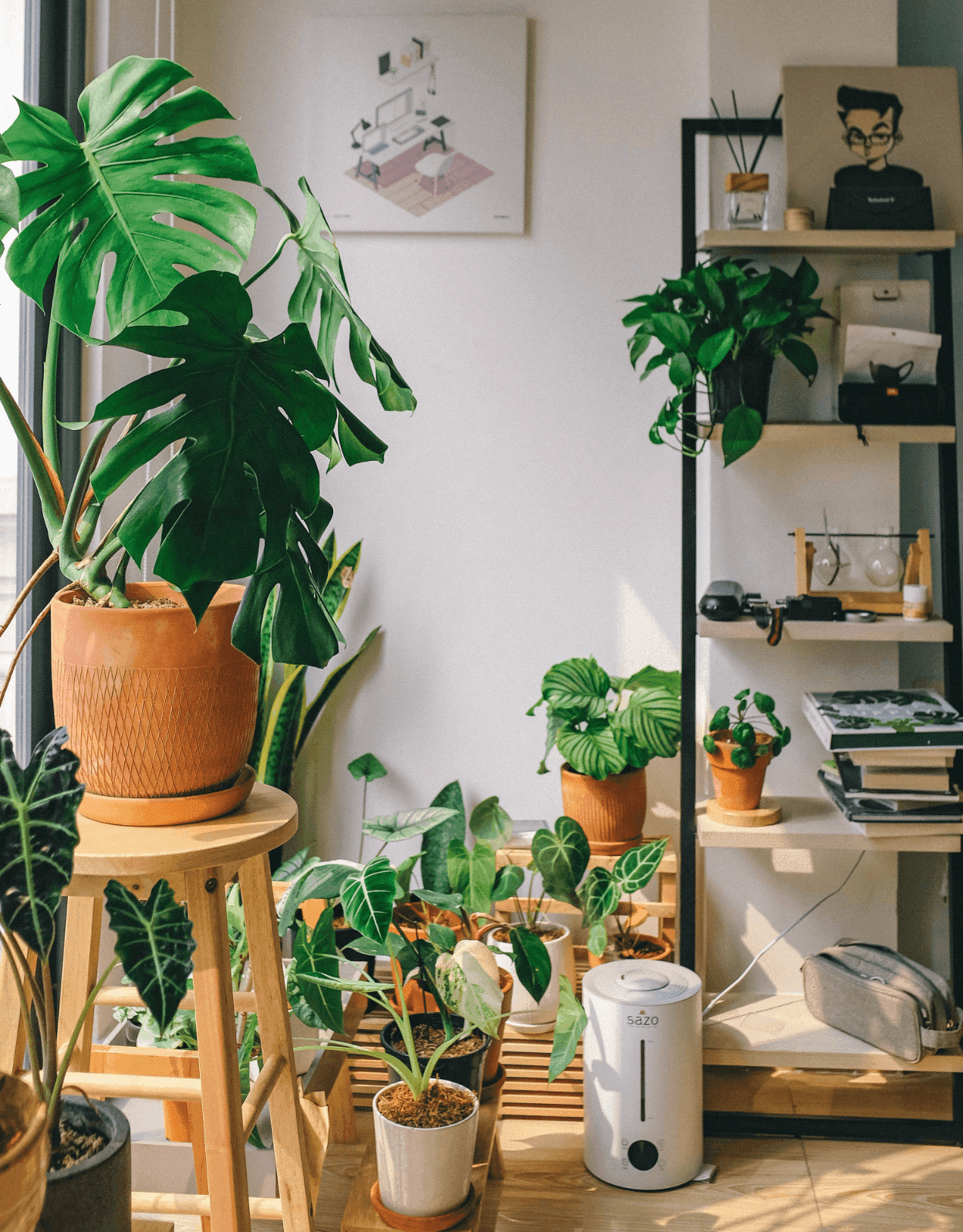
Plants tend to enrich any space. Through photosynthesis they give a little oxygen back to the room, and more than that, they settle the nervous system, a small daily dose of the calm that time in nature brings. Research consistently shows that time spent in and around nature helps regulate the nervous system and reduce perceived stress, and a handful of thriving plants brings a piece of that feeling indoors, softening a space in a way no appliance can.
They will not replace good ventilation or a quality air purifier, which do the heavy lifting on particles and overall air quality. Think of them as companions to clean air, not the primary source of it.
Easiest Indoor Plants for Air Quality
Snake plant, pothos, peace lily, and spider plant are among the best indoor plants for air quality and among the easiest varieties to keep alive indoors, even for beginners.
Your Action Plan
You do not need to do this all at once. Choose one thoughtful improvement this week, then come back for another.
Start here, free and immediate: Open your windows for ten minutes each day. Always run the range hood when you cook, especially on gas. Remove shoes at the door. Replace plug-in air fresheners and paraffin candles with cleaner alternatives.
Small swaps, under $100: A true HEPA vacuum. A hygrometer. A carbon monoxide detector. Beeswax candles. One natural-fiber textile replacing a synthetic one that has reached the end of its life. A couple of the best indoor plants for air quality for a room that needs softening.
When you are ready, bigger investments: A true HEPA plus activated carbon air purifier, one of the best air purifier options for the room where you spend the most consecutive hours breathing. Start with the bedroom.
Make it sacred.
You cannot control the air quality of the whole world, but you can make the indoor air quality of the room where you sleep the cleanest you breathe all day. Start there. Explore the Jaspr Air Scrubber, code SACREDLEE for $200 off.
This is educational content, not medical advice. Nothing here is meant to diagnose, treat, or replace care from a qualified practitioner. Some links are affiliate links. We would rather lose the commission than lose your trust.
SacredLee earns affiliate commissions on some products listed here, at no additional cost to you. We only recommend what has cleared the SacredLee Approved standard. We would rather lose the commission than lose your trust.
Sources
Indoor air is commonly two to five times more polluted than outdoor air: US EPA, Indoor Air Quality.
Gas stoves raise indoor nitrogen dioxide, and venting the range hood outside sharply reduces it: Stanford (2024).
Cooking on a gas stove can release benzene that spreads into other rooms: Stanford (2023).
Indoor air carries more microplastic particles than outdoor air, and synthetic textiles and household dust shed continuously: see the SacredLee Microplastics guide and its cited studies.
True HEPA plus activated carbon (HEPA for fine particles, carbon for VOCs and gases), with CADR matched to room size: US DOE HEPA standard and AHAM CADR ratings.
Ideal indoor humidity of 40 to 50 percent for mold control: US EPA guidance on mold and moisture.